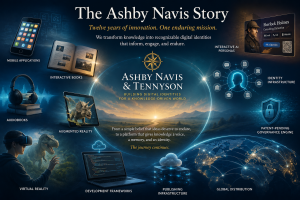
Since 2012 – We’ve been building better ways for knowledge to travel.
When Ashby Navis & Tennyson was founded in 2012, artificial intelligence was still largely the subject of research laboratories and science fiction. We certainly did not set out to build an AI company.
We began with something much simpler.
A belief that technology should help people learn, create, communicate, and preserve ideas.
That belief became our compass.
It has guided every decision we’ve made since.
We have often described Ashby Navis & Tennyson as a workshop rather than a factory.
The distinction is important.
Factories are designed to produce the same thing over and over with increasing efficiency.
Workshops exist for a different purpose. They are places where ideas are explored, tested, refined, and occasionally transformed into something entirely unexpected.
That spirit of curiosity has shaped every chapter of our journey.
Our greatest innovations have rarely begun with answers.
They have almost always begun with a simple question.
What if…?
What if a book could become an app?
What if an audiobook could become an experience?
What if history could answer questions?
What if a business card could become a conversation?
Each question led us somewhere we never expected to go.
Looking back, what once appeared to be separate projects now feel like chapters in a single story.
During our first years we explored nearly every way digital technology could carry ideas forward. We built mobile applications, educational software, interactive books, audiobooks, immersive media, publishing systems, and cloud-based platforms. Each project taught us another piece of the craft.
We learned how software is built.
How stories are published.
How information is organized.
How digital experiences create engagement.
And perhaps most importantly, we learned that technology never stands still.
Platforms evolve.
Devices change.
Software becomes obsolete.
But good ideas deserve to outlive the technology that first carried them.
That realization quietly shaped everything that followed.
As our publishing catalog expanded to hundreds of applications, books, and audiobooks reaching audiences around the world, another pattern began to emerge.
Information had become abundant.
Knowledge had become searchable.
Artificial intelligence had become remarkably capable.
Yet something essential was still missing.
People rarely remember information.
They remember experiences.
They remember conversations.
They remember personalities.
Above all, they remember identity.
That observation changed the questions we were asking.
Instead of asking,
“How do we help people find information?”
we began asking,
“How do we help organizations become memorable?”
The answer wasn’t another database.
It wasn’t another search engine.
It wasn’t simply a larger language model.
The answer was identity.
Today, Ashby Navis & Tennyson creates technology that allows organizations, educators, publishers, museums, businesses, and creators to transform static information into recognizable digital identities.
Those identities do more than answer questions.
They represent organizations.
They preserve institutional knowledge.
They communicate with consistency.
They reflect personality, values, and purpose.
Our first commercial products include Literary Interactive Business Cards and AI-powered digital representatives, but these are only the beginning.
They are the first expressions of a much larger vision.
We believe the next generation of artificial intelligence will not be defined by who has the largest model.
It will be defined by who builds the most trusted identities.
Technology will continue to evolve.
Models will improve.
Platforms will come and go.
Interfaces will change.
But trust, personality, continuity, and identity will remain timeless.
That is why we do not see ourselves simply as a software company, an AI company, or a digital publisher.
We see ourselves as builders of the identity layer that allows knowledge to become conversation, organizations to become memorable, and technology to remain profoundly human.
Our journey began with a simple belief that ideas deserve to endure.
Today, that same belief continues to guide everything we create.
Because every organization has knowledge.
Every memorable organization has an identity.