
White Paper
Ashby Navis & Tennyson LLC
2026
Patent Pending
Author
Michael Morse (“Anthony”)
Inventor
Contributor
Michael Wilson (“Hank”)
Strategic Development & Systems Tactician
Published by Ashby Navis & Tennyson LLC, 2026
About Ashby Navis & Tennyson LLC
Ashby Navis & Tennyson LLC is a digital media and technology company focused on the creation and distribution of intelligent media systems, interactive storytelling platforms, and AI-driven knowledge interfaces.
The company develops software architectures and digital publishing frameworks that integrate artificial intelligence, narrative design, and structured knowledge systems. These technologies are used to produce interactive media, educational experiences, and intelligent digital agents capable of representing organizations, ideas, and historical narratives.
Through research, development, and publishing, Ashby Navis explores the emerging intersection of artificial intelligence, identity systems, and digital storytelling.
Intellectual Property Notice
Certain concepts described in this paper are the subject of a patent-pending application filed by Ashby Navis & Tennyson LLC.
The information presented in this paper is intended to describe high-level architectural concepts and future applications of AI identity systems. Specific implementation methods, algorithms, and technical processes are proprietary.
© 2026 Ashby Navis & Tennyson LLC
All rights reserved.
Portable AI Identity Containers
A Framework for Deployable Organizational Agents
White Paper – Ashby Navis & Tennyson LLC
Executive Summary
Artificial intelligence systems are increasingly being deployed as conversational agents representing businesses, organizations, and individuals. These systems are often designed as chatbots or virtual assistants, yet they frequently lack a consistent identity, governance framework, and organizational alignment.
This paper introduces a conceptual architecture for Portable AI Identity Containers, a framework for constructing AI agents that maintain a consistent personality, factual grounding, and behavioral governance while operating across digital environments.
The proposed architecture organizes AI identity into three foundational layers: Persona, Knowledge, and Governance. Together these layers form a coherent identity structure that can be deployed as a portable AI agent capable of representing an organization in a controlled and reliable manner.
This framework establishes a foundation for the next generation of AI-driven digital representatives.
1. The Emerging Role of AI Representatives
Organizations increasingly rely on digital systems to communicate with customers, audiences, and stakeholders. Over the past two decades, websites and mobile applications have become the primary interface between organizations and the public.
A similar transition is now occurring with conversational AI.
Instead of navigating static pages, users increasingly expect to interact with intelligent systems capable of answering questions, guiding decisions, and presenting information dynamically.
These AI systems may serve roles such as:
- customer service representatives
- product specialists
- educational guides
- brand ambassadors
- organizational historians
- digital receptionists
However, most existing AI systems lack a persistent and well-defined identity structure. Without such structure, AI agents often behave inconsistently, drift from their intended role, or provide responses that misrepresent the organizations they serve.
2. The Problem of Identity in AI Systems
Modern AI models possess powerful language capabilities but lack built-in mechanisms for maintaining organizational identity and behavioral consistency.
Common problems include:
- inconsistent tone and personality
- factual inaccuracies when responding to questions
- misalignment with an organization’s brand or values
- unpredictable conversational behavior
- limited governance over AI responses
These challenges create a need for an architectural framework that can define and enforce a consistent identity for AI agents.
3. AI Identity Architecture
To address these challenges, we propose a conceptual model referred to as AI Identity Architecture.
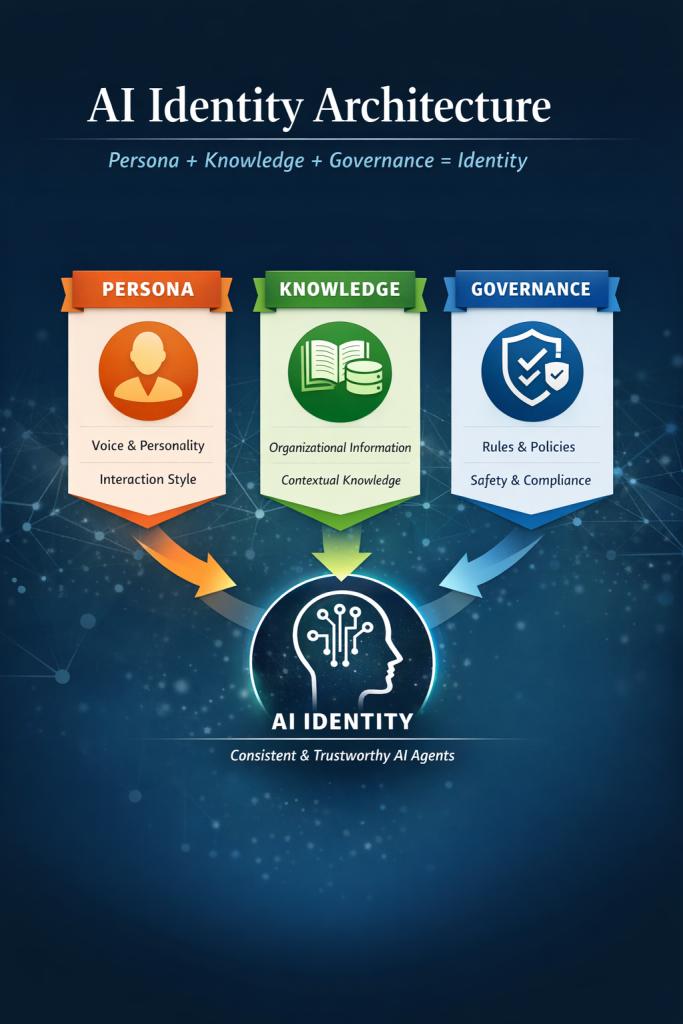
At its core, an AI identity can be understood as the integration of three key components:
Persona
- Knowledge
- Governance
= Identity
Persona Layer
The persona layer defines the stylistic and conversational characteristics of the AI agent. This layer shapes how the AI communicates, including tone, personality traits, and narrative style.
Personas may be inspired by historical figures, literary archetypes, professional roles, or brand-specific identities.
Knowledge Layer
The knowledge layer provides the factual grounding for the AI agent. This includes information relevant to the organization the AI represents, such as services, products, history, policies, or educational content.
Grounding AI responses in structured knowledge helps reduce hallucination and ensures that the system communicates accurate information.
Governance Layer
The governance layer defines the behavioral rules that guide the AI’s interaction with users. These rules ensure that the AI operates within defined boundaries related to safety, professionalism, and organizational standards.
Governance mechanisms help maintain consistent behavior even when the AI is interacting in complex or unpredictable conversational environments.
4. Portable AI Identity Containers
While defining identity is essential, AI agents must also be deployable across various environments.
To support this goal, the identity framework may be packaged into what we refer to as Portable AI Identity Containers.
An AI identity container encapsulates the components necessary for an AI agent to operate as a consistent digital representative.
Conceptually, such a container may include:
- persona definition
- organizational knowledge context
- governance policies
- AI model interface
- user interaction interface
Packaging these components together allows AI identities to be deployed across different systems, platforms, or digital interfaces while preserving consistent behavior.
In effect, AI identity containers allow organizations to treat AI agents as deployable digital representatives, similar to how software containers allow applications to be deployed consistently across computing environments.
5. Example Applications
Portable AI identity containers can support a wide variety of applications across industries.
Potential use cases include:
- interactive business cards
- museum or historical guides
- digital educators and tutors
- AI-powered customer service representatives
- brand ambassadors for organizations
- knowledge assistants for institutional archives
- product specialists for technical companies
In each of these scenarios, the AI agent represents a specific identity while remaining grounded in organizational knowledge and governed by defined behavioral constraints.
6. Governance and Trust in AI Systems
As AI systems become more integrated into everyday communication, governance will become a critical component of responsible AI deployment.
Without governance frameworks, AI systems risk producing responses that are misleading, unsafe, or inconsistent with organizational values.
A governance layer within AI identity architecture can enforce rules related to:
- safety and compliance
- tone and professionalism
- response moderation
- organizational alignment
By combining governance systems with persona and knowledge layers, organizations can deploy AI agents that behave consistently and responsibly.
7. Implications for the Future
The development of AI identity architectures may represent a significant shift in how organizations interact with the public.
Just as websites became the digital front doors of organizations in the early internet era, AI agents may become the conversational interface through which users access information and services.
In such an environment, AI identities will need to be carefully designed, governed, and deployed.
Portable AI identity containers offer a potential framework for managing this new class of digital representatives.
Conclusion
AI systems are rapidly becoming central to how organizations communicate with the world. However, the effectiveness of these systems depends on their ability to maintain consistent identity, accurate knowledge, and responsible behavior.
The framework introduced in this paper, combining persona, knowledge, and governance into portable AI identity containers, offers a conceptual foundation for building the next generation of AI-powered digital representatives.
As AI technology continues to evolve, architectural frameworks such as these may play a crucial role in shaping how intelligent systems represent organizations, institutions, and ideas in the digital age.
Ashby Navis & Tennyson LLC
White Paper – 2026
F.M.I. Contact Us